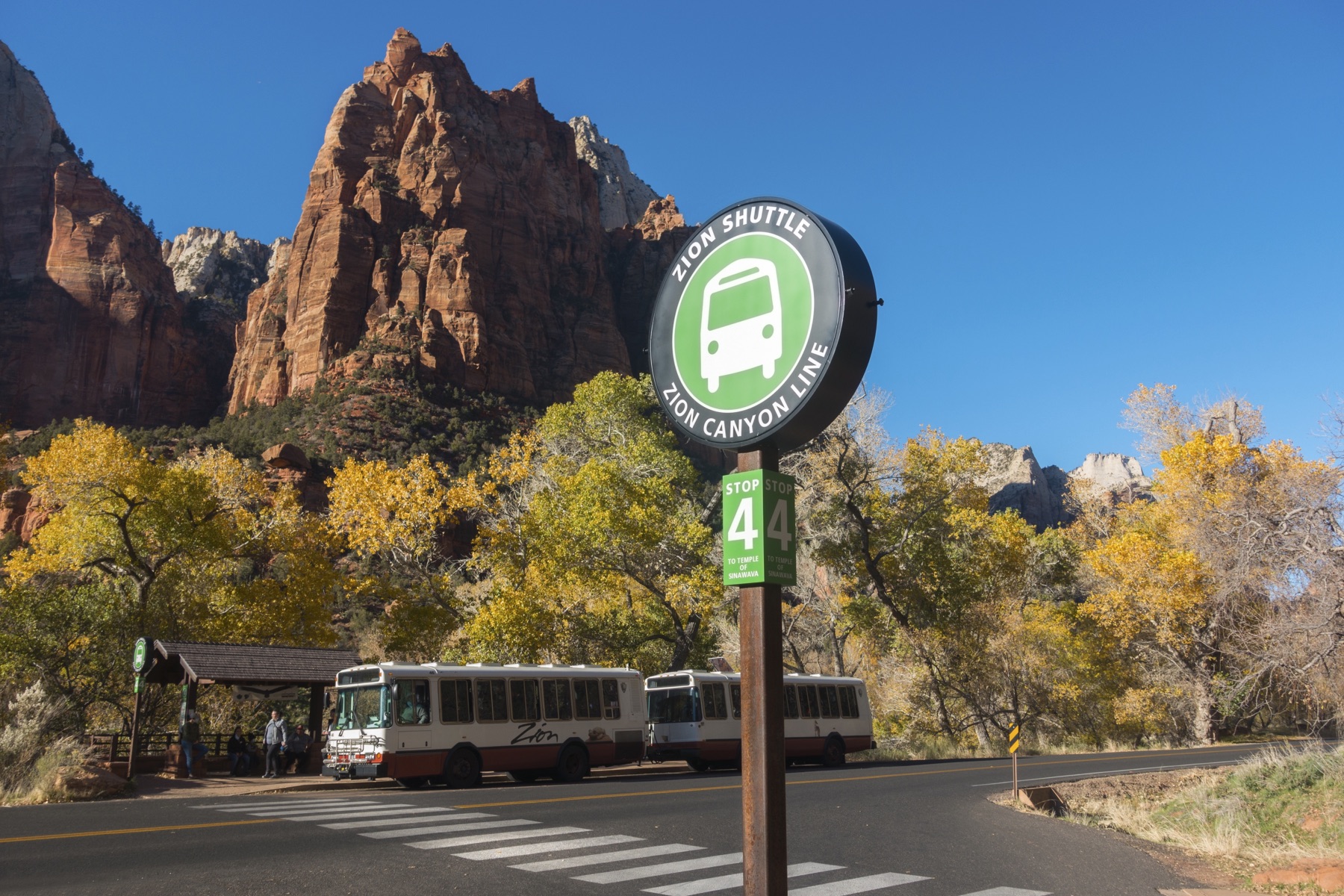
The single thing that trips up first time visitors more than permits, more than weather, more than anything, is transportation. The Zion National Park shuttle is free, it is efficient, and for most of the year it is the only way to reach the canyon’s best trailheads. It is also completely unlike how you get around any other national park, which is why people arrive expecting to drive to the trailhead and end up circling a full parking lot at 9 a.m.
Here is how the system actually works and how to use it without losing half a day.
Why Zion Uses a Shuttle at All
Zion Canyon is narrow. There is one road in and one road out, and the parking at the popular trailheads amounts to a few dozen spaces. When private vehicles were allowed in during peak season, the canyon effectively became a parking lot with a river running through it.
So during shuttle season, the Zion Canyon Scenic Drive is closed to private vehicles. You leave your car at the visitor center or in Springdale and ride in. It moves far more people with far less congestion, and once you accept it, the canyon is a much better place to be.
The Two Shuttle Lines
There are two separate free shuttle routes, and confusing them is the most common visitor error.
The Zion Canyon Line
This is the one inside the park. It starts at the Zion Canyon Visitor Center and runs the length of the scenic drive with nine stops:
- Zion Canyon Visitor Center
- Zion Human History Museum
- Canyon Junction
- Court of the Patriarchs
- Zion Lodge
- The Grotto
- Weeping Rock
- Big Bend
- Temple of Sinawava
End to end takes roughly 40 minutes each way with stops. You can get on and off as many times as you want.
The Springdale Line
This one runs through the town of Springdale, outside the park boundary, with stops near hotels, restaurants, and public parking lots. It ends at the pedestrian entrance, where you walk across the bridge into the park and pick up the canyon line at the visitor center.
Important: the two lines do not connect directly. You walk between them at the pedestrian entrance. And you still pay the $35 per vehicle entrance fee, or show your annual pass, when you walk in.
Which Trailheads Need the Shuttle
Everything on the Zion Canyon Scenic Drive is shuttle access only during shuttle season:
- The Narrows and Riverside Walk. Temple of Sinawava, the last stop.
- Angels Landing and the West Rim. The Grotto.
- Emerald Pools. Zion Lodge or The Grotto.
- Weeping Rock and the Observation Point canyon route. Weeping Rock. Note that the canyon route to Observation Point has been affected by rockfall closures, so check current trail status.
- Court of the Patriarchs viewpoint. Its own stop.
What does not require the shuttle, and this is the useful part:
- Canyon Overlook. On Highway 9 east of the tunnel. Drive right to it.
- Observation Point via East Mesa. Accessed from outside the canyon on the park’s east side.
- Watchman Trail and Pa’rus Trail. Both start near the visitor center.
- The entire east side scenic drive on Highway 9. Open to private vehicles year round.
- Kolob Canyons. Off Exit 40 on I-15, entirely separate, no shuttle.
If the shuttle logistics feel like too much on a given day, those five options make a genuinely full itinerary with your own car. Guests at a tiny home resort near Zion National Park on the Apple Valley side often build one shuttle day and one drive yourself day into a trip for exactly this reason, since the east side and Kolob are easy from that direction and the canyon crowds never enter the picture.
When the Shuttle Runs
Shuttle season generally covers spring through fall, with additional service on some winter weekends and holidays. Exact start and end dates are set each year, so verify on nps.gov before your trip. Outside of shuttle season the scenic drive opens to private vehicles, which is one of the underrated advantages of a winter visit.
During the season, first departures are early in the morning and the last shuttle leaves the Temple of Sinawava in the evening. Know that last departure time before you start a long hike, because it is a hard cutoff and the walk out is nine miles.
The Parking Problem, and How to Beat It
Here is the real bottleneck. The Zion Canyon Visitor Center lot is not large, and in peak season it fills well before 8 a.m. Once it is full, you are hunting for paid parking in Springdale and riding the town shuttle in, which adds 30 to 45 minutes to your morning.
The fix is simple and it is the same fix for almost every Zion problem: leave earlier. Being at the visitor center by 6:30 or 7 a.m. means you park, you walk on to the first shuttle, and you are at your trailhead before the crowd arrives.
That is easier from a place with a full kitchen. Coffee and breakfast at 5:30 on your own deck, out the door by 6:15. Zion’s Tiny Getaway is a tiny home resort near Zion National Park in Apple Valley, 30 minutes from the south entrance via the Smithsonian Butte Scenic Byway, and every home has a full kitchen and locally roasted Utah coffee. The 5:30 a.m. start is a lot more pleasant when you are not looking for somewhere that is open.
One routing warning worth repeating: navigation apps often send drivers from Apple Valley around through Hurricane, which is 45 to 50 minutes. The Smithsonian Butte Scenic Byway is the 30 minute route.
Riding It Well
A few things that make the Zion National Park shuttle work better:
Ride to the end first. Take the shuttle all the way to the Temple of Sinawava, then work your way back down the canyon, catching stops on the return. The buses fill up as they head up canyon and empty out coming down.
Expect lines mid morning. Between roughly 9 and 11 a.m. you may wait through more than one bus at the visitor center. Before 8 and after 3 it is a different park.
You can walk between stops. The Pa’rus Trail parallels the lower canyon and is a pleasant walk. If a line is long, sometimes walking is faster.
Buses are wheelchair accessible and have bike racks with limited capacity.
No food on board, and no pets except service animals. Zion is broadly restrictive with dogs, with the Pa’rus Trail being the notable exception.
The Bigger Picture
Once you understand it, the shuttle stops being an obstacle. It is the reason the canyon still feels like a canyon. Plan around it rather than against it: arrive early, ride to the top, work your way back, and keep the non shuttle trails in your back pocket for the days you want to move on your own schedule.
The other half of that plan is where you sleep. A tiny home resort near Zion National Park that is 30 minutes out gives you an easy early start and somewhere genuinely worth returning to when the canyon gets hot and busy in the afternoon. Zion’s Tiny Getaway has 40 boutique tiny homes with private decks, propane fire pits, BBQs, and full kitchens, plus select homes with private hot tubs and rooftop decks for the evening.
Get the Zion National Park shuttle figured out before you arrive, be in the lot by 7, and the rest of the day takes care of itself. Book direct for the best rate and set your alarm.
Frequently Asked Questions
Is the Zion National Park shuttle free?
Yes. Both the in park canyon line and the Springdale town line are free to ride. You still pay the $35 per vehicle entrance fee, or show an annual pass, to enter the park.
Do I have to use the shuttle at Zion?
During shuttle season, private vehicles are not allowed on the Zion Canyon Scenic Drive, so yes for canyon trailheads like The Narrows and Angels Landing. Canyon Overlook, Observation Point via East Mesa, the Highway 9 east side, Watchman, Pa’rus, and Kolob Canyons are all drivable.
How many stops does the Zion shuttle have?
The canyon line has nine stops, from the Zion Canyon Visitor Center up to the Temple of Sinawava. End to end takes roughly 40 minutes each way with stops, and you can get on and off as often as you like.
What time should I arrive to get parking at Zion?
Aim to be at the visitor center by 6:30 or 7 a.m. in peak season. The lot often fills before 8. Staying somewhere with a full kitchen makes that start easy. Zion’s Tiny Getaway is 30 minutes out via the Smithsonian Butte Scenic Byway with coffee and breakfast in your own home.
Does the Zion shuttle run in winter?
Shuttle season generally runs spring through fall, with limited service on some winter weekends and holidays. Outside the season the scenic drive opens to private vehicles, which makes winter visits simpler. Confirm current dates on nps.gov.
Ready to Book Your Zion Basecamp?
Zion’s Tiny Getaway is 30 minutes from the park via the Smithsonian Butte Scenic Byway. Private decks, propane fire pits, full kitchens, and select homes with private hot tubs. Book direct for the best rate.