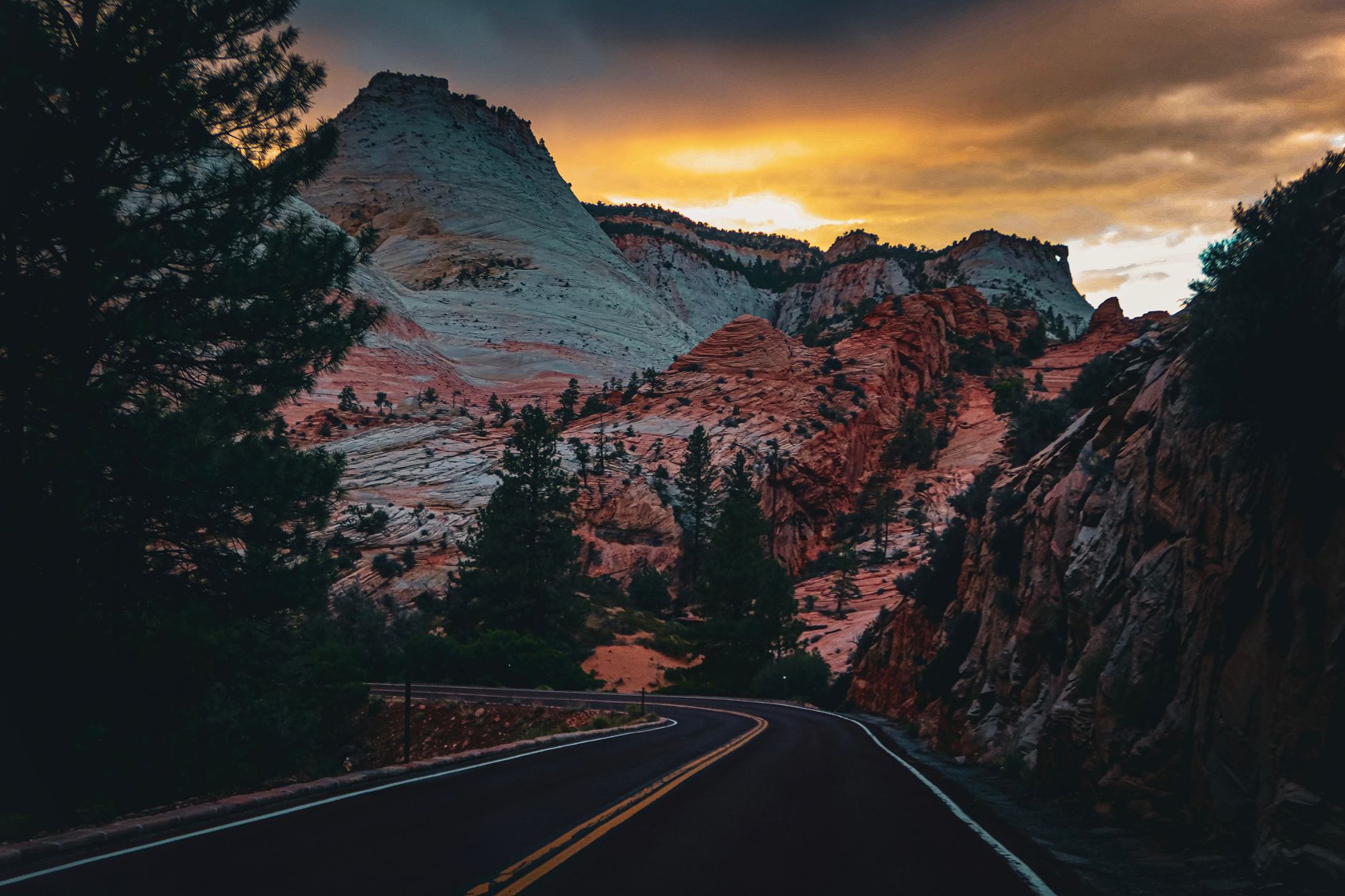
You decided on Wednesday. You are leaving Friday. Every article you have opened so far has told you to book six months out, enter a lottery in February, and reserve a campsite you obviously do not have. Ignore all of it. A weekend trip to Zion National Park is very doable on short notice, as long as you know which doors are still open and which ones closed months ago.
Here is the honest version: what you can still get, what you cannot, what it costs, and how to build a two-day plan that does not depend on winning anything. Lodging is usually the real bottleneck, which is where a tiny home resort near Zion National Park 30 minutes outside the park changes the math.
The Good News: You Do Not Need a Reservation to Enter Zion
Start here, because this is the thing people get wrong. Zion has no timed entry and no day-use reservation system. The Park Service states it plainly: you do not need a permit or a reservation to enter the park. Drive up, pay at the gate, go.
That puts Zion in a different category from several other western parks, and it is the single biggest reason a last-minute weekend works here. The only day hike in the park gated behind a lottery is Angels Landing, and even that has a same-week path, which we will get to.
What a Last-Minute Zion Weekend Costs to Get In
- Private vehicle: 35 dollars, valid 1 to 7 days, covers everyone in the car
- Motorcycle: 30 dollars, valid 7 days
- On foot or bicycle: 20 dollars per person age 16 and up, under 16 free
- America the Beautiful annual pass: 80 dollars, accepted here, covers one private vehicle
- Zion annual pass: 70 dollars, valid 12 months from the month of purchase
One note for international visitors: as of 2026 the park lists an additional 100 dollar per-person fee for non-US-resident visitors age 16 and up, waived if you hold an Annual or America the Beautiful pass. Worth checking the fee page before you go so it is not a surprise at the gate.
The One Permit You Can Still Win This Week
Angels Landing requires a permit beyond Scout Lookout, and the seasonal lotteries close months ahead. But there is a second lottery built specifically for people in your situation.
The day-before lottery opens at 12:01 a.m. Mountain Time and closes at 3:00 p.m. Mountain Time the day before you want to hike. Results go out after 4:00 p.m. that same day, by email through recreation.gov. The application fee is 6 dollars, non-refundable, and covers a group of up to six. If you are awarded a permit there is an additional 3 dollars per person, and for the day-before lottery that per-person fee is non-refundable too.
Two things to plan around. First, you are applying the day before, so you can enter the lottery from the road on Friday for a Saturday hike. Second, do not build your weekend around winning it. Treat it as a bonus.
Worth knowing: the permit is only required past Scout Lookout. The hike up to Scout Lookout itself, switchbacks and all, needs no permit and no lottery. Plenty of people do that and decide the chained section was never the point.
What Is Genuinely Off the Table on Short Notice
Being realistic saves you a wasted evening. These need advance planning and are not weekend-of options:
- The Narrows top-down, the 16 mile through-hike from Chamberlain’s Ranch, requires a permit
- All technical canyoneering requires a permit
- Overnight backpacking and wilderness trips require a permit
- The Subway runs a seasonal lottery that opens up to four months ahead, though it does have a daily lottery for leftover spots that you apply for two days before your trip, midnight to 3:00 p.m. Mountain Time, with a 6 dollar application fee plus 10 dollars per person
What You Can Hike With No Permit at All
This is the part that makes a last-minute weekend trip to Zion National Park work. Almost the entire park is walk up and go.
- The Narrows, bottom-up from the Temple of Sinawava. No permit is needed to hike upstream as far as Big Spring. This is the iconic Zion experience and it is available to anyone who shows up.
- Riverside Walk, 2.2 miles, about 57 feet of gain, paved, with the first 0.4 miles wheelchair accessible
- Lower Emerald Pool, 1.2 miles, 69 feet of gain
- Watchman Trail, 3.3 miles, 368 feet of gain, starting right at the Visitor Center
- Canyon Overlook, 1 mile round trip on the east side of the tunnel, with a view that outperforms the effort. Parking is extremely limited, so go early.
- Scout Lookout, the Angels Landing approach up to the permit boundary
Before you commit to The Narrows, check two things. The hike closes to all travel when the Virgin River runs above 150 cubic feet per second, and whenever the National Weather Service issues a Flash Flood Warning. Below 70 CFS is moderate walking and 70 to 150 CFS is challenging but open. The current flow is published on the USGS gauge for the Virgin River at Springdale, and closures go on the park’s conditions page.
There is also a standing park-wide advisory about toxic cyanobacteria in the Virgin River and the park’s other streams. The guidance is to avoid submerging your head, not to drink instream water, and not to touch algae mats. It is an advisory rather than a closure, and it is worth reading the current version before you get in the water.
How the Shuttle Works, and Why It Decides Your Morning
During shuttle season, Zion Canyon Scenic Drive is closed to private vehicles. You cannot drive to the Narrows trailhead, Angels Landing, or the Emerald Pools. The shuttle is how you get there, and the good news is that it is free and needs no ticket or reservation. Buses run roughly every 5 to 10 minutes.
The 2026 operating windows:
- May 17 to September 12: first bus 7:00 a.m., last bus from the Visitor Center 7:00 p.m., last bus out of the canyon from the Temple of Sinawava 8:15 p.m.
- September 13 to October 24: first bus 7:00 a.m., last from the Visitor Center 6:00 p.m., last out 7:15 p.m.
- October 25 to November 28: first bus 7:00 a.m., last from the Visitor Center 5:00 p.m., last out 6:15 p.m.
- November 29 to December 25: no shuttle service
- December 26 to January 2: holiday service
Private vehicles are allowed on the Scenic Drive only in the off season, which the park describes as usually December through February. If you are visiting in winter, that changes your whole day for the better.
The 9 A.M. Problem
The Park Service is blunt about this: all parking lots in Zion Canyon are usually full by 9:00 a.m. Shuttle waits at the Visitor Center are longest between 8:00 a.m. and noon and can run over 30 minutes, with buses standing-room-only for most of the day. In extreme congestion the park will turn traffic around at the South Entrance.
So the plan is simple. Be through the gate and parked before the lots fill. That is the whole trick, and it is the one thing that separates a good Zion weekend from a frustrating one.
For timing the season itself: June is the park’s busiest month at about 12 percent of annual visitation, with May and July close behind, and 65 percent of all visits land between April and September. January and February are the quietest at about 3 percent each. If your last-minute weekend falls in the shoulder season, you have picked well.
A Two-Day Plan That Does Not Depend on Luck
Saturday: the canyon
Leave early enough to be parked before the lots fill. Ride the shuttle to the Temple of Sinawava and hike The Narrows bottom-up as far as you feel like going, turning around whenever you have had enough. Come back down for a late lunch, then take the shuttle to Zion Lodge and walk the Emerald Pools. If you entered the Angels Landing lottery and won, swap the afternoon for Scout Lookout and the chains.
Sunday: the east side
Skip the shuttle entirely. Drive Highway 9 east through the Zion-Mount Carmel Tunnel and hike Canyon Overlook, one mile round trip for one of the park’s best views. Then keep driving east and let the scenery do the work. The east side is a completely different landscape from the canyon floor, it is drivable in your own car, and almost nobody plans for it.
Both days work better if you are not starting from inside the canyon traffic. Basing at a tiny home resort near Zion National Park on the quiet side of the park means Saturday starts with a drive in rather than a fight for a parking space in town.
Whatever the weekend looks like, check the park’s conditions page the morning of. Closures, flash flood watches, and road restrictions change day to day.
Where to Stay When Springdale Is Already Booked
This is where last-minute trips usually die. Springdale sits at the park entrance with a limited number of rooms, and on a good weekend it sells out well ahead. Looking 15 miles further out is what turns a no into a yes.
Zion’s Tiny Getaway is in Apple Valley, Utah, about 30 minutes door to door from the park entrance via the Smithsonian Butte Scenic Byway off Main Street. The byway comes out on Highway 9 in Rockville, four miles west of Springdale and the park entrance, so you approach the park from the quiet side instead of crawling through town.
One thing to know before you drive: Google Maps does not route you over the byway. It sends you around through Hurricane and La Verkin, which takes 45 to 50 minutes. Take the Smithsonian Butte Scenic Byway instead.
Our 40 boutique tiny homes have private decks, propane fire pits, BBQs, full kitchens, private baths, high-speed WiFi, air conditioning, and locally roasted Utah coffee. Select homes add a private hot tub, a rooftop deck, or a skylight for stargazing, and several are pet-friendly. There is a community fire pit, an outdoor kitchen, a picnic area, lawn games, and a playground on site. For a weekend where you are out the door before sunrise and back covered in Virgin River silt, a full kitchen and a hot tub are worth more than a hotel lobby.
Hurricane is about 20 minutes away for groceries and last-minute gear, which matters when you packed in a hurry. St. George is 45 minutes and Kanab is an hour east.
Go This Weekend
A last-minute weekend trip to Zion National Park is not a compromise. No reservation to get in, no permit for the park’s most famous water hike, a lottery you can still enter the day before, and a shuttle that costs nothing. The only piece worth solving quickly is where you sleep. Book direct at our tiny home resort near Zion National Park, wake up 30 minutes from the park, and be parked before the lots fill.
Frequently Asked Questions
Do you need a reservation to visit Zion National Park?
No. Zion has no timed entry and no day-use reservation system. The National Park Service states that you do not need a permit or reservation to enter the park. The only day hike requiring a permit is Angels Landing, beyond Scout Lookout.
Can you still get an Angels Landing permit at the last minute?
Yes, through the day-before lottery. It opens at 12:01 a.m. Mountain Time and closes at 3:00 p.m. Mountain Time the day before your hike, with results emailed after 4:00 p.m. that same day. The application fee is 6 dollars for a group of up to six, plus 3 dollars per person if you are awarded a permit. Both fees are non-refundable for this lottery.
How much does it cost to get into Zion National Park?
A private vehicle is 35 dollars and the pass is valid for one to seven days. A motorcycle is 30 dollars. On foot or by bicycle it is 20 dollars per person age 16 and up. The America the Beautiful annual pass costs 80 dollars and is accepted.
Do you need a permit to hike The Narrows?
Not for the bottom-up hike. No permit is needed to hike upstream from the Temple of Sinawava as far as Big Spring. The top-down through-hike from Chamberlain’s Ranch does require a permit. The Narrows closes when the Virgin River runs above 150 cubic feet per second or when a Flash Flood Warning is in effect.
Is the Zion shuttle free and do you need a ticket?
The Zion Canyon shuttle is free and requires no ticket, permit, or reservation. Buses run roughly every 5 to 10 minutes. While the shuttle is running, Zion Canyon Scenic Drive is closed to private vehicles.
Where can you stay near Zion at the last minute?
Springdale sells out early on busy weekends, so look further out. Zion’s Tiny Getaway in Apple Valley, Utah is about 30 minutes door to door from the park entrance via the Smithsonian Butte Scenic Byway, with 40 tiny homes, full kitchens, fire pits, and select homes with private hot tubs.
Ready to Book Your Zion Basecamp?
Zion’s Tiny Getaway is 30 minutes from the park via the Smithsonian Butte Scenic Byway. Private decks, propane fire pits, full kitchens, and select homes with private hot tubs. Book direct for the best rate.