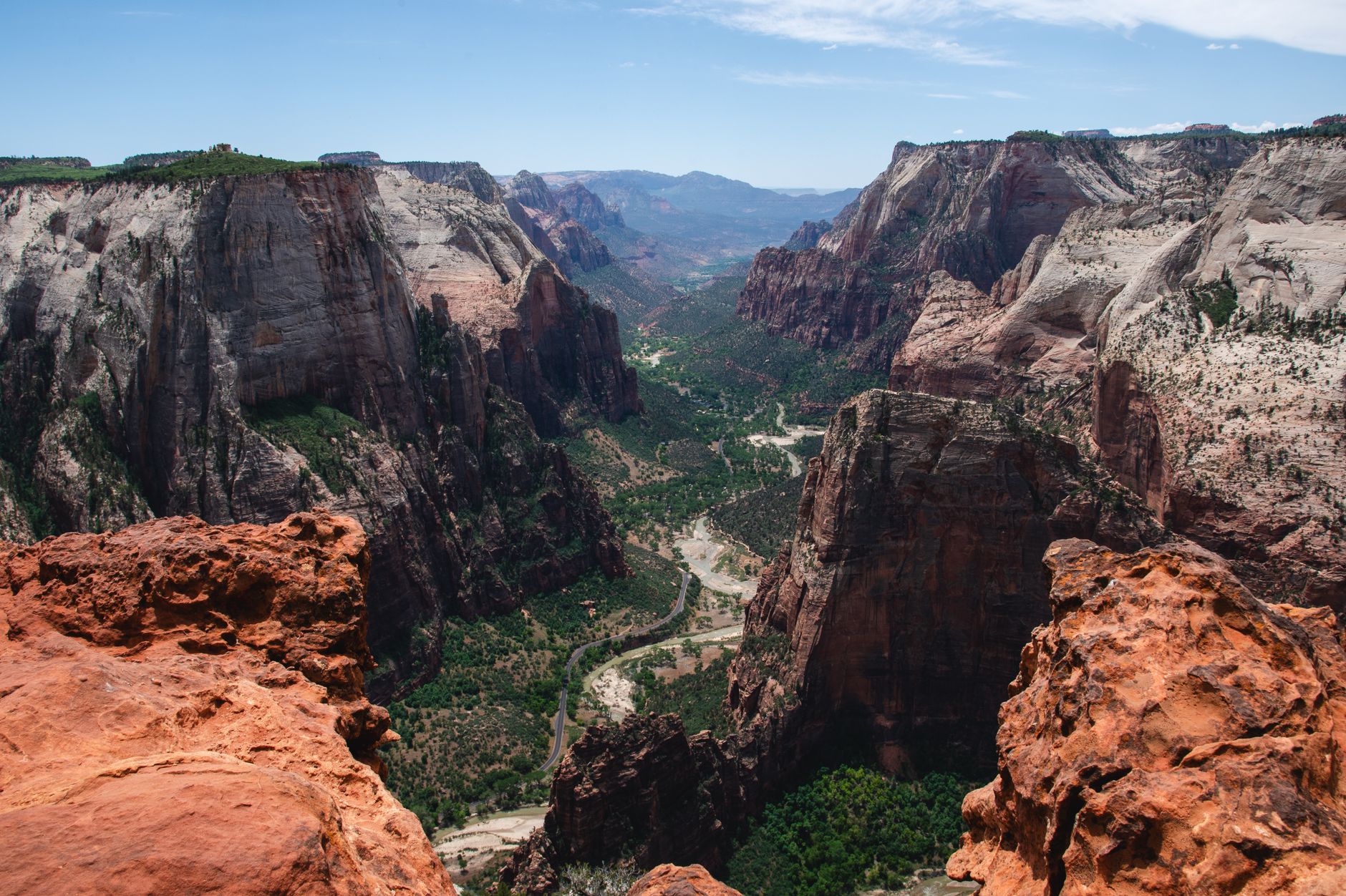
Ask a Zion regular to name the single best view in the park and most of them will not say Angels Landing. They will point you a few hundred feet higher, to Observation Point, where you look straight down on Angels Landing with the entire canyon unrolled beneath you. Since the 2019 rockfall closed the classic route from Weeping Rock, the Observation Point East Mesa trail has become the standard way to reach this famous overlook, and honestly, that is good news for hikers. The East Mesa approach trades relentless switchbacks for a mellow mesa-top walk, skips the permit lottery entirely, and delivers you to a viewpoint that many people consider the finest in all of Zion National Park.
This guide covers everything you need to plan the hike: how the trail actually feels on the ground, how to reach the trailhead, how it compares to Angels Landing, and where to base yourself for the trip. If you are building a multi-day Zion itinerary, staying at a tiny home resort near Zion National Park puts you within striking distance of this hike and every other corner of the park.
Why the Observation Point East Mesa Trail Is Now the Standard Route
For decades, hikers reached Observation Point by climbing out of Zion Canyon from Weeping Rock, a steep, dramatic route carved into the cliff face. In 2019, a major rockfall closed that trail, and it has remained closed ever since. The park’s answer, and the route virtually everyone uses today, is the East Mesa Trail.
Instead of climbing up to the viewpoint from the canyon floor, the East Mesa route starts on the plateau above it. You begin at roughly the same elevation as Observation Point itself and walk across the mesa to reach it. The result is a hike of roughly 7 miles round trip with only modest elevation change, most of it gentle rolling terrain through ponderosa pines and manzanita.
Here is what makes this route so appealing:
- No permit required. Unlike Angels Landing, which now requires a lottery permit through recreation.gov, the Observation Point East Mesa trail is open to anyone who shows up.
- Mostly flat walking. The mesa top rolls gently. Strong hikers move fast here, and families with older kids handle it comfortably.
- A quieter experience. Because the trailhead sits outside the main canyon and off the shuttle system, crowds are a fraction of what you will find on Zion’s headline hikes.
- The same world-class payoff. The viewpoint at the end is identical to the one hikers earned the hard way for generations.
What to Expect on the Trail
The hike itself is refreshingly straightforward. From the East Mesa trailhead, the path heads west across the plateau. You will pass through open stands of pine, cross a few sandy stretches, and catch teaser views into side canyons along the way. Navigation is easy, the trail is well worn and signed at the key junction.
The final stretch is where the magic happens. The trees fall away, the mesa narrows, and suddenly you are standing on the rim of Zion Canyon at Observation Point. From here you look down on Angels Landing, which sits noticeably below you, and out over the full sweep of the canyon: the Virgin River threading the valley floor, the Great White Throne, and red rock walls stacked in every direction. On a clear day the view runs for miles.
How Hard Is It?
Most hikers would call the Observation Point East Mesa trail moderate, and that is mostly about distance rather than steepness. Seven miles round trip is a real walk, but with gentle grades the whole way, it is far less punishing than any of Zion’s canyon-floor climbs. Plan on roughly 3 to 4 hours of hiking at a relaxed pace, plus however long you want to linger at the viewpoint. Trust us, you will want to linger.
What to Bring
- More water than you think you need, there is no water source on the mesa
- Sun protection, shade comes and goes between the pines
- Layers, the mesa sits at higher elevation than the canyon floor and stays cooler, especially in spring and fall
- Snacks or lunch to enjoy at the overlook
- A camera, this is arguably the most photogenic viewpoint in the park
Getting to the East Mesa Trailhead
This is the part that trips people up, so read carefully. The East Mesa trailhead is not on the Zion Canyon Scenic Drive, and the free park shuttle does not go anywhere near it. You reach it from the east side of the park, off Highway 9, via North Fork Road.
- From the park’s east entrance area on Highway 9, turn onto North Fork Road.
- Follow North Fork Road north for several miles. This is a dirt road, generally passable for most vehicles in dry conditions, but it can get rough and slick after rain or snow.
- Watch for the signed East Mesa trailhead and park in the small pullout area.
A few practical notes. Check the weather before you commit, because a wet North Fork Road is no fun in a low-clearance car. If you would rather not drive it at all, shuttle services operating out of Springdale run hikers to this trailhead, which also lets you skip the parking scramble. And remember that Zion’s entrance fee, currently 35 dollars per vehicle for a 7-day pass, applies to your visit even though this trailhead sits on the park’s quieter side.
One more advantage of coming at Zion from outside the main corridor: if you are staying at a tiny home resort near Zion National Park rather than in the middle of the Springdale bustle, you are already positioned to move flexibly between the canyon, the east side, and the surrounding backroads without fighting for parking every morning.
Observation Point East Mesa Trail vs. Angels Landing
Plenty of visitors agonize over which of these two icons to hike. Here is the honest comparison.
- The view: Observation Point wins. It sits well above Angels Landing and takes in the entire canyon, including Angels Landing itself. It is the view of the view.
- Permits: Angels Landing requires a lottery permit through recreation.gov. The Observation Point East Mesa trail requires nothing but a park pass and a pair of shoes.
- Exposure: Angels Landing’s chained ridgeline is famous for a reason, and it is not for everyone. East Mesa has no white-knuckle sections at all, which makes it the clear choice for anyone uneasy with heights.
- Crowds: East Mesa is dramatically quieter. On many mornings you will share the viewpoint with a handful of people instead of a hundred.
The best answer, if you have the time and win the lottery, is to hike both. Standing on Angels Landing and then looking down at it from Observation Point a day later is one of the great one-two punches in American hiking.
When to Hike It
Spring and fall are prime time, the same March through May and September through November window that suits Zion as a whole. Summer works too, since the mesa’s elevation keeps temperatures more forgiving than the canyon floor, but start early and carry extra water. In winter, snow can linger on the plateau and North Fork Road becomes unpredictable, so check conditions before making the drive.
For light and photography, aim for morning. The canyon walls glow, the haze is minimal, and you will have the trail largely to yourself.
Where to Stay: Your Basecamp for East Mesa and Beyond
A hike like this rewards a good basecamp, somewhere you can roll out early, come back dusty, and actually relax. That is exactly what Zion’s Tiny Getaway was built for. Our 40 boutique tiny homes sit in Apple Valley, Utah, just 30 minutes from Zion National Park via the scenic Smithsonian Butte Byway, one of the prettiest drives in the region and a worthy part of the trip in its own right.
Every home comes with a private deck, propane fire pit, BBQ, full kitchen, private bath, high-speed WiFi, air conditioning, and locally roasted Utah coffee for those early trailhead mornings. Select homes add a private hot tub for post-hike recovery, a rooftop deck, or a skylight positioned for stargazing under some of the darkest skies in the Southwest, and several are pet-friendly. Around the property you will find a community fire pit, an outdoor kitchen, a picnic area, lawn games, and a playground, so the evenings are as good as the hikes.
The location works in your favor, too. Hurricane is about 20 minutes away for groceries and gear, St. George is 45 minutes, and Kanab sits an hour to the east, which makes day trips in every direction easy. After a morning on the mesa, you can grill dinner on your deck, soak in the hot tub, and watch the stars come out over the desert.
The Best View in Zion Is Waiting
The Observation Point East Mesa trail proves that the finest view in Zion does not require a permit, a lottery win, or a fight with your fear of heights. It just requires a morning, a good pair of shoes, and a plan for getting to the trailhead. Make that plan from the right basecamp and the whole trip gets easier. Book your stay at our tiny home resort near Zion National Park, book direct for the best rate, and wake up 30 minutes from the park with coffee in hand and the best view in Zion on the day’s agenda.
Frequently Asked Questions
Do you need a permit to hike Observation Point via East Mesa?
No, the East Mesa Trail to Observation Point does not require a permit. You only need a Zion National Park entrance pass, currently 35 dollars per vehicle for 7 days. This makes it a great alternative to Angels Landing, which requires a lottery permit.
How long is the Observation Point East Mesa trail?
The East Mesa route is roughly 7 miles round trip. Most hikers finish in about 3 to 4 hours at a relaxed pace, plus time spent enjoying the viewpoint.
How hard is the East Mesa Trail to Observation Point?
It is considered moderate, mostly because of the distance rather than the terrain. The trail follows gently rolling mesa-top terrain with only modest elevation change, so there are no steep switchbacks or exposed sections.
How do you get to the East Mesa trailhead?
The trailhead is on the east side of Zion, reached from Highway 9 via North Fork Road, a dirt road that can be rough after rain. There is no park shuttle to this trailhead, so you drive yourself or use a shuttle service from Springdale.
Where should I stay when hiking Observation Point via East Mesa?
Zion’s Tiny Getaway in Apple Valley, Utah is an ideal basecamp, just 30 minutes from Zion National Park via the Smithsonian Butte Byway. The boutique tiny home resort offers 40 homes with full kitchens, private decks, and fire pits, and select homes have private hot tubs for post-hike recovery.
Ready to Book Your Zion Basecamp?
Zion’s Tiny Getaway is 30 minutes from the park via the Smithsonian Butte Byway. Private decks, propane fire pits, full kitchens, and select homes with private hot tubs. Book direct for the best rate.